
Light the Fire: An Tine ag Lasadh
It is a peculiarly aggressive presumption of the modern mind that all that is can be understood without the transformation of the self, that every experience we have can always be contextualized without either upset or personal dissolution in however small a degree with the person our histories have produced. There is a vicious truth that the fruit born of this presumption belittles and diminishes who we are by the diminishment of what we find in the past. In presuming that the work of our predecessors can be subjected to our intellect without the mitigating and ennobling force of our admiration and openness of mind we shackle ourselves to being only what we have been. One of the best examples of this may be found in the eighth century composition known now as “The Cauldron of Poesy.”
Images of cauldrons abound despite their scarcity in our magnificent modern complex, particularly around Samhain. What with the witches, ghosts, and skeletons scattered down the endless aisles of your favorite economic temple to the industrial complex, Hallowe’en is the rare moment when the reality of the cauldron, diminished as it is into a two dimensional symbol, asserts itself and breaks free from its benighted descendent: the common stove-top pot. (Though I very much appreciate the fact that Elvira, Mistress of the Dark, made the transition with neither comment nor mishap in her movie by the same name.) As you might suspect, there is much boiling in the Great Cauldron of our collective Culture than one might appreciate at first glance, but I’m not writing to unpack it here. This post is written to redress a terrible lacuna in the World Wide Web.
Many write about The Cauldron of Poesy online. Ok … really only a few do, but none of them clearly cite their sources or present the text proper. This posting aims to remedy that with my own version of the text intended to make (a however slightly more) correct pronunciation more accessible. My translation is meant to add a further appreciation of the text’s meaning and hopefully, along with the comments below, encourage some to venture into the twisted tangle of classic Irish myth.
There were two previous editions and translations of the poem that carry the title ‘The Cauldron of Poesy:’ Liam Breatnach’s “Cauldron of Poesy” in Ériu 32 and P.L. Henry’s in Studia Celtica 14—15, both published in 1981, though Breatnach published corrections to his in 1984. The first printed edition of the text, though, was written by Annie Power in 1913, and you can still read her text at the Internet Archive in Anecdota from Irish Manuscripts (vol. 5, pp 22—28). All of this pales to the text in the original manuscripts however, and you can find it through the Irish Script On Screen website or the CODECS site (the Collaborative Online Database and E-resources for Celtic Studies). There are two manuscripts cited in these editions: Trinity College Dublin MS 1337 53—57, and the Egerton MS 152 in the British Library (London, f 51. though this doesn’t seem to be digitized yet). If you want to have a look at Breatnach’s edition and translation (which I highly recommend), you can register for a free account at JSTOR or log in through a social media account like Google to get access to 100 articles every month. (A paid subscription allows the downloading of PDFs.) The English text provided here as a translation is almost entirely Liam Breatnach’s.
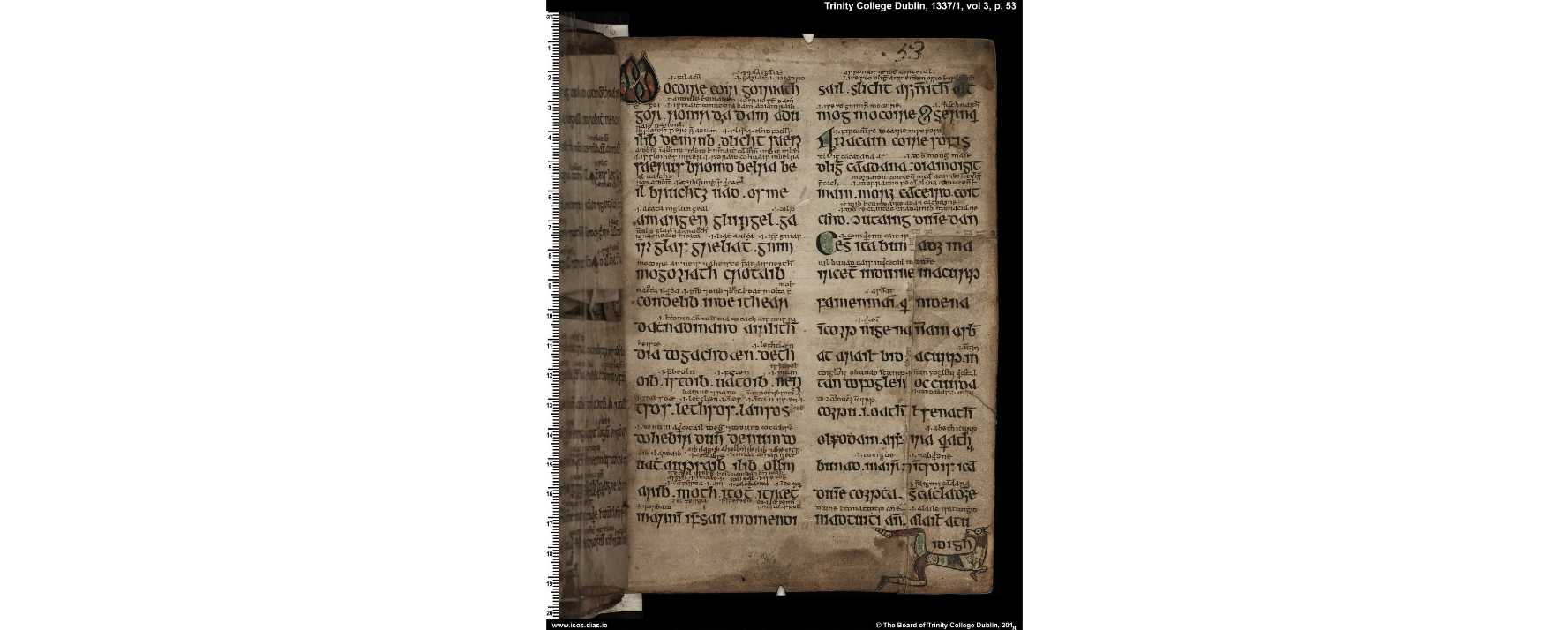
This is p. 53 from TCD MS 1337. You can see the words “Mo Coire” at the very top.
There are by comparison a great deal of musings on the cauldrons from various interested parties, many of whom look to the idea of the three cauldrons within each of us as part of a spiritual landscape. Far from disdaining such interpretations, I feel that both their and the work of academics tend to not go far enough. Scholars are famously reluctant to compare the cauldrons to the chakras, as Penny Billington did in her lecture posted on Druidcast, just as popular writers tend to evince a proclivity towards the metaphorical, shying away from … what shall we call it: the practical evocative aspect of this tradition, an energetically efficacious reading? Whatever the case or the terminology, the simple fact is that access to the Coiri an Dánta or the Three Cauldrons of the Gifts as they might be styled, is not to be found easily online. It is very important, however, that as many people as possible have access to the original text and some kind of translation. I’m offering my take on it here.
Add The Ingredients: Damhnaí an Éigis
First, I'm not printing here a slavishly accurate edition. The goal is to stick fairly closely to the original language, but reproduce it here with an orthography that looks more familiar to those who can read modern Irish. None of the idioms are modernized, simplified or changed. It’s too beautiful for that, and anyway there’s a good chance that something might come for me in my sleep if I do change it too much. Even some of Breatnach’s emendations have been reverted to the form in the manuscript.
Secondly, just the primary text will be printed here and not the interlinear glosses that are also supplied in the manuscript. Breatnach’s edition and translation offer some really helpful insights drawn from these: to say that it’s worth studying Breatnach’s take on it is a gross understatement, mostly because he gives his typically powerful analysis of the grammar and metrics to say nothing of the sheer breadth of his comprehension of the material. His scholasticism is uncompromising to a fault, and I’d rather err on the side of accessibility. His goal was to provide the most accurate and academically correct representation of the original, early text in the manuscript, but part of the reason I’m choosing this very different orthographic convention is that the next step is to record a proper reading with visuals for the new-to-be-formed Coire YouTube channel! as part of the Electric Legendarium.
Third, and probably least useful to most people, there are a few comments and notes on the text and terminology that should be added.
Much of the text, being concerned with coiri (cauldrons), deals with the notion of turning. The modern Irish term for this is iompú from the Old Irish impód (which I’m writing as impúdh), the verbal noun of imm-sói. The meaning of this verb hinges on pivoting. (See what I did there?) It can be taken in the sense of a tipping or reversal: think the turn of the tide, turning into something else, and even revolution, so the association with a cauldron makes sense. You can tip it and its contents will spill. That -sói element is the part that carries the meaning of turning. The imm- part of it is the preposition ‘around,’ so the literal meaning of imm-sói is to ‘turn about’ as of something revolving around an axle. Compare this with as-soí, ‘to turn away from’ (as- is the preposition for ‘away from’ — think ex in Latin); do-soí, meaning ‘to turn to’ in the sense of ‘to bring forth;’ con-soí, ‘to turn with’ in the sense of a turning toward something; and ind-sói meaning ‘to turn in’ in the sense of returning or conversion — think “it’s late; I’m going to turn in now.”
Breatnach dates this poem to the first half of the eighth century and certainly no later than the ninth, the interlinear gloss being added much later. This leads to a great deal of emendation as the manuscripts are both very late. Take the last line of the first passage which in MS 1337 runs slicht asinnethar alt mog mocoire. He renders this as sliucht as-indethar altmod mo choiri. Altmod is essentially an apposative nominative subject of as-innethar, translating the line as “(this is) the way by which is related the nature of my cauldron.” In the notes he explains that altmod is basically a compounded, appositional whichy-whatnot (academically called a “dvandva-compound”) and supposed to be something like “workable-function-thingy.” This doesn’t really address the possible confusion with mog, a low-class male — think old Chicago slang “you dirty mug!” How we take alt mog has pretty serious consequences for our understanding of the early medieval Irish intellect, but in the interest of getting on with it I’ll just trust to Breatnach’s experise. In fact, it’s just best to trust his expertise in general.
The Cauldron of Poesy, which in the tradition seems to have been referred to as Coire Goriath or Coire Érmai (Breatnach’s choice for a native title), is really about knowledge and the nature of knowledge. The terms for knowledge that keep coming up are variations of fios, particularly sous which is a kind of contracted form of sofhios. (The words are pretty much interchangeable.) Fios is a verbal noun properly of the Old Irish ro-finnadar meaning “to discover” or “find out.” It denotes those things we come across through investigation and coincidence, the compound so-fhios denoting ‘good’ knowledge in the sense of happy, beneficial or even higher knowledge. Eagna is another word meaning ‘wisdom,’ and there are a great many others. Soí is one that comes up in explaining the word ‘éarmae.’ It is glossed elsewhere as so-aí, which is a compound analagous to so-fhios but swapping ‘poetic inspiration’ for ‘knowledge.’ The similarity between soí and imm-sói could suggest a kind of resonance between the idea of high artistic sensibilities in soí and the evolving of poetic ability in imm-sói, though this is hardly the kind of thing any academic would risk their reputation on.
Similarly, there are a great many terms that are rooted deeply in the Celtic poetic tradition. Modh, todh and træth; airnin, forsail, dínann dísháil: these are terms packed with a great deal of context. The best place to start getting a handle on them is the Auraicept na nÉces, more properly the Uraicceacht na nÉices. A PDF of the Auraicept edited and partially translated by George Calder is available through the Internet Archive.
The Cauldrons of Poesy: a Trí Coiri na Dánta
Moí choire cóir Goiriath gor.
Rond n-ír Día domh a duilib ndémhribh;
dliocht saor saorus broinn béalrae mbil brúchtas úadh.
Os mé Amairghen glúngheal. garrglas. grélíath.
gnímh mo Ghoriath crothaibh condeilghibh.
indeathear dath nádh ionann .
airleathar Día do gach dáen.
de thaobh. is taobh . úas taobh .
neamh-tsous . leathshous . lánshous .
do hEbhir Dunn déanamh . do uath.
aidhbhsibh ilibh ollmaribh.
I moth . i dtoth . i dtræth .
i n-airnin, i bhforsail, i n-díneann díoshail,
sliocht as-innithear altmodh mo choire.
Mine is the proper Cauldron of Goiriath,
warmly God has given it to me out of the mysteries of the elements;
a noble privilege which ennobles the breast
is the fine speech which pours forth from it.
I being white-kneed, blue-shanked, grey-bearded Amairgen,
let the work of my goiriath in similes and comparisons be related
- since God does not equally provide for all,
inclined, upside-down (or) upright -
no knowledge, partial knowledge (or) full knowledge,
in order to compose poetry for Ebher and Donn
with many great chantings,
of masculine, feminine and neuter,
of the signs for double letters, long vowels and short vowels,
(this is) the way by which is related the nature of my cauldron.
Ara-caun Coire So-Fhis
searnar dligheadh cach dána.
dia móighit maoín .
mórus cach ceird coitcheann.
con-utaing duine dán.
I acclaim the Cauldron of Knowledge
where the law of every art is set out
as a result of which prosperity increases
which magnifies every artist in general
which exalts a person by means of an art.
Cairm i dtá bunadhus ind aircheadal i nduiniu; insa chorp fa i n-anmain? As-bearat araili bidh i n-anmain ar ní ddénai in corp ní cen anmain. As-berat araili bidh i gcorp. In tan dano fo-ghlean ag cundu chorpthai .i. ó athair nó sheanathair ol shodhain. As fhíru ara-thá bunadh. In airchetail agus in t-shois . i gcach duiniu chorptha. acht cach la duine ní adtuíthi ann. alailiu atuídhi.
Where is the source of poetic art in a person, in the body or in the soul? Some say in the soul since the body does nothing without the soul. Others say in the body since it is inherent in one in accordance with physical relationship, i.e. from one's father or granfather, but it is more true to say that the source of poetic knowledge is present in every corporeal person, save that in every second person it does not appear; in the other it does.
Caite didhiu bunadh ind archeadail agus gach sois olchenae? Ní ansae. gainitir tri coiri i gcach duiniu .i. Coire Goriath agus Coire Érmai agus Coire Sois.
What does the source of poetic art and every other knowledge consist of? Not difficult; three cauldrons are generated in every i.e. the Cauldron of Goiriath and the Cauldron of Érmae and the Cauldron of good of Knowledge.
Coire Goiriath is é-sidhe gainethar fáon i nduiniu fo chétóir. Is as fo-dháiltear sous do dhoínibh i n-óghoítiu.
The Cauldron of Goiriath, it is that which is generated upright in a person from the first; out of it is distributed knowledge to people in early youth.
Coire Érmai, immorro, iarmo-bí impúdh móighid; is é-sidhe isesi gaineathar do thaoíbh i nduiniu.
The Cauldron of Érmae, then, after it has been converted it magnifies; it is that which is generated on its side in a person.
Coiri Sois, is é-sidhe gaineathar for béolu agus is as fo-dháiltear sous cach dána olchenae cenmo-thá aircheadal.
The Cauldron of Knowledge, it is that which is generated upside down, and out of it is distributed the knowledge of every other art besides poetic art.
Coire Érmai dano gach la duine is fora bhéala atá ann .i. i n-áes dois. Leathchlaon i n-áes bairdne agus rann . is faon atá i n-ánshrothaib sofhis agus aircheadal. Conidh airi didhiu. ní dénai cách óeneret di h-ágh is fora bhéala atá Coire Érmai and conidh n-iompuí brón no fháilte.
. The Cauldron of Érmae, then, in every second person it is upside down, i.e. in ignorant people. It is on its side in every person who practice bairdne and raind. It is upright in the ánroth’s of knowledge and poetic art. And the reason, then, why every one else does not practice at that same stage is because the Cauldron of Érmae is upside down in them until sorrow or joy converts it.
Ceist: cis lír fodhlai fil forsin mbrón imidh-suí? Ní ansae; a ceathair:. eolchaire . cumha . ocus brón éoit ocus ailithre ar Día. 7 is medhón ata-tairberat inna ceathai-se cíasu aneachdair fo-feartar.
How many divisions are there of the sorrow which converts it? Not difficult; four: longing, grief, and the sorrow of jealousy, and exile for the sake of God, and it is internally that these four make it upright although they are produced from outside.
Atáat dano dí fhodhail for fáilte ó n-iompoíthear i gCoire Sofhis .i. fáilte déodhae 7 fáilte dóendae.
There are, then, two divisions of joy through which it is converted into the Cauldron of Knowledge: divine joy and human joy.
Ind fháilte dóendae, atáat cethéoir fodlai for suidi .i. lúth éoit fuichechtae 7 fáilte sláne 7 nemhimnedche, imbidh bruit 7 biidh co feca in duine for bairdni 7 fáilte fri dligedh n-éicse iarna dagfrithgnumh 7 fáilte fri tascor n-imbais do-fuaircet noí cuill cainmeso for Segais i sidhaibh, conda-thochrathar meit moltchnaí iar ndruimniu Bóinde frithroisc luaithiu euch aige i mmedón mís mithime dia secht mbliadnae beos.
As for human joy, it has four divisions: (i) the joy of sexual longing, and (ii) the joy of safety and freedom from care, plenty of food and clothing until one begins bairdne, and (iii) joy at the prerogatives of poetry after studying it well, and (iv) joy at the arrival of imbas which the nine hazels of fine mast at Segais in the Sídh amass and which is sent upstream along the surface of the Boyne, as extensive as a wether’s fleece, swifter than a racehorse, in the middle of June every seventh year regularly.
Fáilte déodae immorro tórumae in raith déodhai dochum in Choiri Érmai conidh n-impoí fóen conidh dee biit fáidi déodhai 7 dóendai 7 tráchtairi raith 7 frithgnama imaile . conaidh íarum labhrait inna labharthu raith 7 dogníat inna firta, condat fásaighe 7 breatha a mbríathar, condat desimreacht do cach cobrai . Acht is aneachtair ata-tairberat inna hí-siu in coire cíasa medhón fo-feartar
Divine joy, moreover, is the coming of divine graceto the Cauldron of Érmae, so that it converts it into the upright there are people who are both divine and secular prophets and commentators both on matters of grace and of (secular) learning and they then utter godly utterances and perform miracles, and their words are maxims and judgements, and they are an example for all speech. But it is from outside that these make the cauldron upright, although they are produced internally.
De shin a n-as-ber Nédhe mac Adhnai.
Concerning that which Nédhe mac Adhnai said.
Ar-caun Coire nÉrmai intleachtaibh raith
rethaibh sofhis sreathaibh imbais .
indbher n-eagnai eallach suíthi
srúaim n-ordan. indogbháil daor.
domhnadh insce intleacht ruirtheach
rómhnae roiscni. sáer comhgni .
cáemhadh fealmac, féaghthar ndligheadh .
deilighthear cíalla. ceangar sési
sílaighthear sofhis. sonmigthear soír.
saorthar nádh saor ara-utgatar anmann
ad-fíadatar moltae modhaibh dlighidh .
deligthibh grádh glanmeasaibh soíre .
soinscibh súadh srúamannaibh suíthi .
sóerbrudh i mberbthar bunadh cach sofhis
searnar íar ndligiudh drengar íar frithgnumh.
fo-nglúasi imbas. ime-soí fáilte faillsigther. tri brón
búan brígh nádh díbhdhai dín.
Ar-caun Coire Érmai.
I acclaim the Cauldron of Ermae
with understandings of grace with accumulations of knowledge
with strewings of imbas, (which is) the estuary of wisdom
the uniting of scholarship the stream of splendour
the exalting of the ignoble the mastering of language
quick understanding the darkening of speech
the craftsman of synchronism the cherishing of pupils,
where what is due is attended to where senses are distinguished
where one approaches musical art where knowledge is propagated
where the noble are enriched where he who is not noble is ennobled.
Where names are exalted, where praises are related
by lawful means with distinctions of ranks
with pure estimations of nobility with the fair speech of wise men
with streams of scholarship, a noble brew in which is brewed
the basis of all knowledge which is set out according to law
which is advanced to after study which imbas quickens
which joy converts which is revealed through sorrow;
it is an enduring power whose protection does not diminish.
I acclaim the Cauldron of Érmae
Cidh a n-érmae? Ní ansae. ér-iompúdh soí nó iar-iompúdh soí nó éraim soí .i. earnaidh sofhis. 7 soíri . 7 airmitin iarna iompúdh.
What is the érmae? Not difficult; an artistic noble turning. artistic 'after-turning' or an artistic ‘after-turning’ or an artistic course; i.e. it confers good-knowledge (sofhios) and status and honour after being converted.
Coire Érmai ernidh . ernair.
Mroghaith mroghthair. bíathaidh bíadhtair
máraidh. márthair. áilith áiltir .
ar-cain ar-canar . fo-righ fo-reghar.
con-searnn con-searnnar . fo-searnn fo-searnnar.
The Cauldron of Érmae. It grants, it is granted
It extends, it is extended. It nourishes, it is nourished
It magnifies, it is magnified. It requests, it is requested of
It acclaims, it is acclaimed. It preserves, it is preserved
It arranges, it is arranged. It supports, it is supported
Fó tobar tomhseo. Fó atrabh n-insce
Fó comhar coimseo. Con-udaing firse
Good is the source of measuring. Good is the acquisition of speech,
Good is the confluence of power which builds up strength.
Is mó cach fearunn. Is fearr cach orbhu.
beridh co h-ecnae. echtraidh fri borbhu.
It is greater than any domain. It is better than any patrimony,
It brings one to wisdom. It separates one from fools
Interpretations and Takeaways
There is a huge amount to unpack here, especially since there’s no easy translation for some of the terms. That this represents a uniquely Gaelic view of how poetic capability intersects with the mind and body goes without saying, so it’s fairly important to “wade into the weeds” with what’s going on here.
The basic model is that each of us has three cauldrons: one that warms, one that moves, and one that provides Good knowledge — and that capital G is deliberate. When we are born the Coire Goriath (cauldron of warming) is upright, the Coire Érmae (cauldron of movement) is on its side in half the people and upside-down for the other half, while the Coire Sofhis (cauldron of good knowledge) is upside down in everyone. If a cauldron is upside down then it’s empty, so we can take this to mean that one’s Coire Goriath is full at birth while our knowledge is empty, though this shouldn’t be taken as a belief in the “blank slate” at birth. The Coire Érmae is pretty clearly conceived as a sense of emotional intelligence: if you’re able to compose poetry that moves people at all then the cauldron is at least on its side, and it is turned up through joy and sorrow (fáilte agus brón). The Coire Sofhis actually doesn’t have too much explication beyond it being the source of every art besides poetic art, but there are two passages that suggest something more is going on.
The first is this: is as [an Coiri Goriath] fo-dháiltear sous do dhoínibh i n-óghoítiu; “it is out of the Cauldron of Warming that Sofhios is divvied out to people in their youth.”This seems to suggest that the Cauldron of Warming acts as the Coire Sofhis for young people, possibly as intuition or instinct. The other is this: atáat dí fhodhail for fáilte ó n-iompoíthear i gCoire Sofhis; “there are two divisions upon joy out of which it is rotated into the Cauldron of Good Knowledge.” I’ve deliberately switched up the translation here because iompoíthear literally means to turn it around as on its hanging handle, tipping into the Coire Sofhis. It is possible I suppose that it could mean a transformation, but it makes more sense to me that the flow of aí, that is poetic, inspired knowledge and proficiency, is being brewed in one cauldron and poured into another, like a brewed mead being poured into a secondary fermenter. The transformation of the contents, then, starts to make more sense of how poetic art is of the Coire Érmae and not the Coire Sofhis. The Coire Érmae is the heart-centre and the source of emotion. That is why it must be activated by fáilte agus brón. The Coire Goriath corresponds to our gut instincts that warm the body before our emotions move us to take action.
The emotional range of the Coire Érmae sheds further light on this as well. We get four sorrows, four human joys, and the divine joy of inspired grace.
The sorrows are enumerated as eólchaire, cumha, brón éoit and ailithre ar Día. Eólchaire is probably a compound of eól from which we get eólas for knowledge and caire which is a word for a fault or guilt. In this way, eólchaire should be taken as knowledge of a fault, which would make it seem like a sense of self-recrimination or regret but could just as easily cover the sense of sadness that comes from seeing a wrong perpetrated in the world. In this way it would cover both pity and regret and would match our use of “I’m sorry” when we are expressing sympathy. Cumha on the other hand is clearly grief in the sense of suffering a loss, though eólchaire and cumha according to modern dictionaries are interchangeable. Brón éoit literally translates as “heaviness of jeaousy” not in the sense of romantic possessiveness but the bitter emotional weight of longing to be better than someone else. Ét is glossed with the Latin word aemulatio, from which we get ‘emulation,’ but the sense is this hate-fueled rivalry that comes from the spiteful desire to surpass another. Finally, ailithre ar Día is quite literally “otherness for God,” ailithre being the word for retreating to a monastery, going on pilgrimage and otherwise removing oneself to a life of penitence. This means having no creature comforts, no heartfelt human companionship, and no end to it in sight beyond death itself.
For fáilte, it’s not enough to just talk about “joy” as the terms used here differ. Fáilte is our word here, familiar from the omnipresent céad míle fáilte, but lúth is the word used to illustrate it in its human, corporal form. Lúth is a word for energy, vigor, motive force, and even happiness. It’s that get-up-and-go that prompts unconscious smiles and hyperfocus alike, but here we get lúth eóit fuicheachtae. Now this is quite the phrase. We’ve already met ét, but ét fuicheachtae seems to be doing … something else here. Fuicheacht is the abstract quality of being a fuiche, and that means being a cuckold. The Dictionary of the Irish Language suggests that fuicheacht probably means just some lascivious state, but ét fuicheacht would literatlly translate as “jealousy of cuckoldry.” It’s hard to think of the energy that springs from that as a “joy,” unless we focus instead on that quality of wanting to be better than someone that ét seems to suggest in aemulatio. We then have an urge to action in lúth, the desire to surpass in ét and sexual promiscuity unhindered by marital boundaries in fuicheacht. The fáilte in this then is the very corporeal joy of sexual conquest and the lurid appeal of seeing it in others.
We then get a progression of joys from this lusty, sexual passion through the joy of the full larder and comfy house, through the benefits of the poet’s place in society to the more transcendent joy of poetic inspiration — though the reference to a seven-year cycle related to the nine hazel-trees of wisdom is a bit difficult to parse out. The gist is clear: each of these joys is ranked from the basest to the more refined. Similarly, the divine joy is the direct inspiration of divine grace in the poet which leads to the excellent use of language, insight and even miracles, completing the joys as a cohort of nine that fill the Coire Érmae and tip it into the Coire Sofhis. Because the Coire Sofhis doesn’t produce poetic art itself but all other skills, starts out empty and is fed by the Coire Érmae, it’s clear that poetic art is the support and font of all other skills. This is why it is so important to Gaelic culture; éigse is literally the foundation for all other thought and mental activity, and it’s fueled by emotion. Small wonder the Celtic seems so romantic.
Personally, I see these cauldrons corresponding to our gut, heart and head respectively, though an argument could be made against that. In this way, the Coire Goriath is our belly, warming us physically and offering instinct and the wisdom of the body. The Coire Érmae offers emotions through our heart-centre and is the source of genuinely excellent poetry, though it requires experience and the uplifting of inspiration to engage the Coire Sofhis, which I identify with the head. This is just my own interpretation. This makes much sense out of how accomplished warriors like Cú Chulainn and Conal Cernach were, and why so many terms and phrases relating to heightened intellectual states relate to fire and flame, to say nothing of cooking and brewing.
What do your cauldrons tell you?