
Cracked Foundations
Codex I.L13
Gaiatic Calendration: M13036.713
Modulus I: Foundations for Learning Gaelic
Perhaps ‘foundation’ is the wrong term here as it is a perchance misleading.The foundations in question are the linguistic foundations for the Gaelic languages poured by the Academy over the last two centuries.
They are offered here during the course of Lughnasadh, the násadh Logha or ‘Funereal Games of Lugh.’ Of course these are not the funereal games for Lugh, but rather the commemorative oenach instigated by Lugh, the Master of All Arts and Supreme Guarantor of Oaths. He instigated them in honor of his foster mother, Tailtiu, shortly after the Tuatha Dé Danann arrived in Ireland coinciding with the onset of the ripening fruit for the harvest. Perhaps it would be better to have called this the Gathering of Bitter Fruits, as the purpose here is to gather the key sources for learning the Gaelic language, not from Gaelic culture itself as would be right and proper but from the Academy’s apparatus.
Such fruits are bitter because these represent an objective description from the outside, the leavings of dissectors and analysts rather than the inspired bards of the tradition itself, and, since our own culture of learning and language is an offshoot of their dissecting and analytic protocols, these texts must serve as the foundation for our first faltering introduction to the language. Some comfort may be gleaned from the fact that the bards themselves used the grammatical apparatus at the core of these academic descriptions, so if you are interested in learning the Gaelic language in any of its forms, please read on.
Modulus II: Grammatical Terms & Background
The apparatus in question is of course the European tradition of grammar with its parts of speech supplemented by the etymological research of modern philology. For this tradition of grammar we may quote Book I of the Libri de Speculo Mirabile:
What is grammar? Not hard that; grammar is a metalanguage we use to talk about how we make meaning through language. Whence language? From lingua meaning “things of the tongue” for it is with the tongue that sounds are shaped and cut into syllables. What is a syllable? Not hard: a syllable is a simple collection of sounds represented by letters that can combine to form words. What is the difference between syllables and words? Not hard that: words are syllables with meaning, e.g “mailc” has no meaning, but “claim” means to seize or take up something. Thus “”mailc” is merely a syllable but “claim” is a word. Words may have multiple syllables as in “reclaim” made of the proclitic syllable“re-” and the word “claim.” As letters are to syllables, and syllables are to words, words are to phrases which are collections of words that make sense: e.g. “the great red dog” or “never had been thought of.” Such phrases then make up clauses which are complete statements like “the lad claimed that the great red dog never had been thought of.” ‘Clause’ from the Latin clausus, and this is true for the clause encloses meaning and intention within it that it may go out into the world and take its effect where it may.
— Chapter I, Liber De Fundamentis
How words act in a sentence determines their part of speech: these are nouns, verbs, adjectives, adverbs, prepositions, pronouns, conjunctions, articles and interjections. If a word acts as the subject of a verb, the object of a verb or preposition, or modifies another noun through apposition or taking a genitival form, then it is itself a noun. A verb is a word that denotes an action and so on. If these are difficult terms or cause any kind of confusion or dismay, please watch the following videos: they should alleviate some of your distress.
These concepts — the parts of speech, syntax (which is how words connect with each other to form meaningful statements), and the various descriptions of how words change and relate to one another — are key to the works listed below, many of which presume that the reader already understands them.
Modulus III: Sources for the Gaelic Language
Gaelic as a language goes back to Old Irish, which eventually became Middle Irish in the tenth century. Around 1200 or a little before, a form of literary or Classical Gaelic had developed, and this was used in manuscripts until conflict with the colonial English in the seventeenth and eighteenth centuries achieved the vilification of Gaelic culture. The first reference to a Scottish dialect of Gaelic appeared shortly after that, but it can be presumed that local, regional dialects were always a reality. When the bardic orders were dissolved, however, these dialects became the only form of Gaelic to survive. Now they generally fall into the following: Scots Gaelic, Northern Irish, Connacht Irish, Southern Irish and Manx, though Scots Gaelic and Manx are often referred to as separate languages now in the same way that Ulster Scots and Lallans (Scots Language) are often considered separate from English.
Johann K. Zeuss’ Grammatica Celtica
This is the first grammar of Celtic languages, but it’s in Latin, so it is included here purely for interest’s sake.
Rudolf Thurneysen’s Grammar of Old Irish (Osborn Bergin & D.A. Binchy trans.)
This is the monumental description of the Old Irish Language first published in German in 1909 as Handbuch des Alt-Irischen. Thurneysen died in 1940 working on an English translation of his book (with key updates), so the work was completed by Bergin and Binchy after the War ended.
David Stifter’s Sengoídelc: Old Irish for Beginners
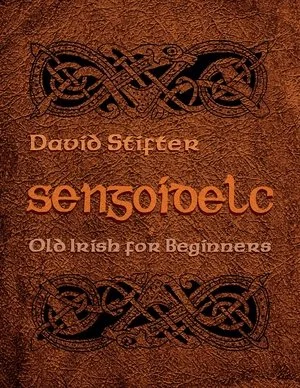
This is a full course in book-form. Where Thurneysen’s book is a straight description of the language, Stifter’s starts with the basics and leads you chapter by chapter toward facility with the language. It’s well worth the purchase price. You can purchase it through Amazon here or directly from Syracuse University Press here.
Another similar and often useful book is Ruth Lehman's Introduction to Old Irish.
John Strachan’s Old Irish Paradigms
This should be considered a companion to Thurneysen’s Grammar of Old Irish because it presents articles, nouns and verbs in full tables (called paradigms) so you can see exactly all the forms that a word can take. It is for reference, but as such is completely essential.
The Dictionary of the Irish Language
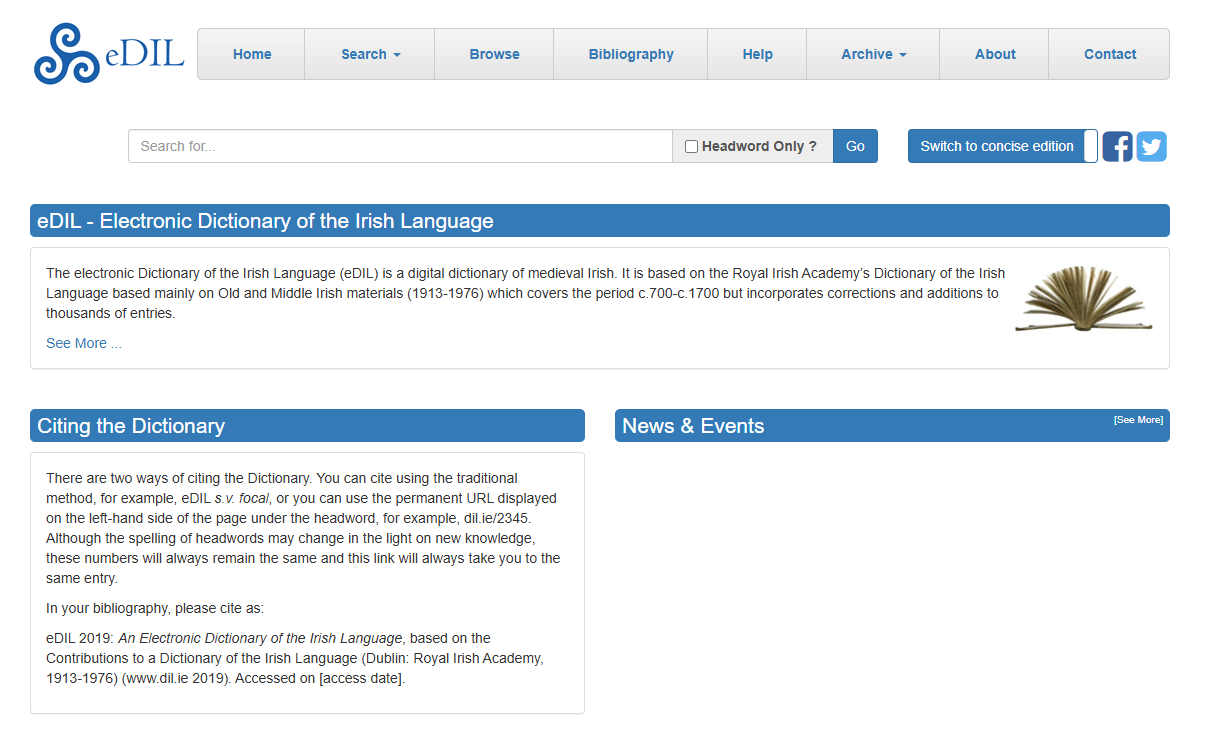
This website is utterly essential for anyone interested in the Gaelic languages. The only things to be cautious about are 1) spelling is in Old Irish (so takes a little getting used to), 2) the Browse feature will reset if you press ‘Enter’ (so you need to just start typing a few letters to see all the words that start with that combination), and 3) it’s written by academics (so it tends to be a little sterilized in terms of connotations).
Teanglann (Modern Irish Online Dictionary)
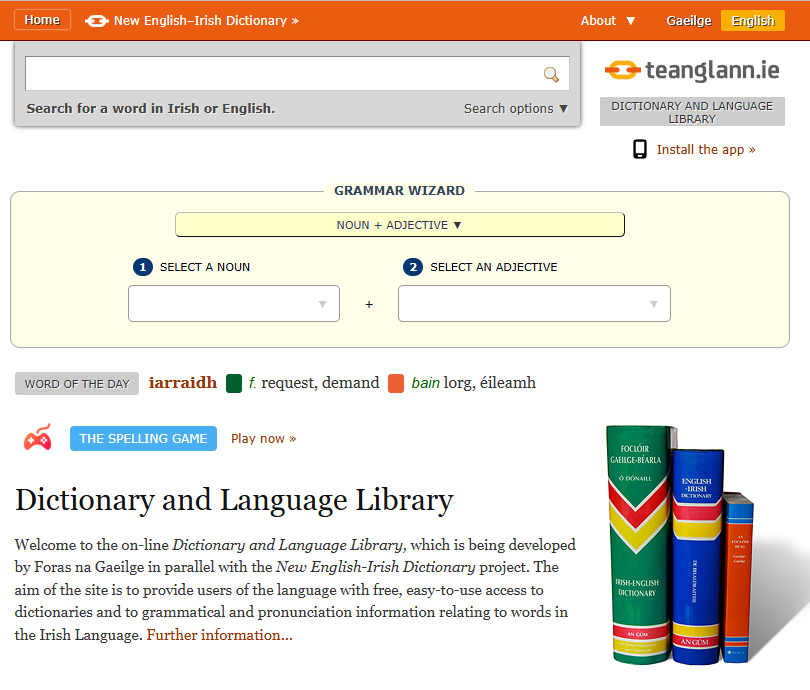
Actually several dictionaries in one, this website is the best source for Modern Irish, including grammatical paradigms, pronunciations, and intuitive interfaces for searching multiple dictionaries. The only drawback is that it sticks to the modern, standardized Irish spelling (devised in the middle of the last century) so often deviates critically from its Old Irish roots.
Am Faclair Beag (Dictionary of Scots Gaelic)
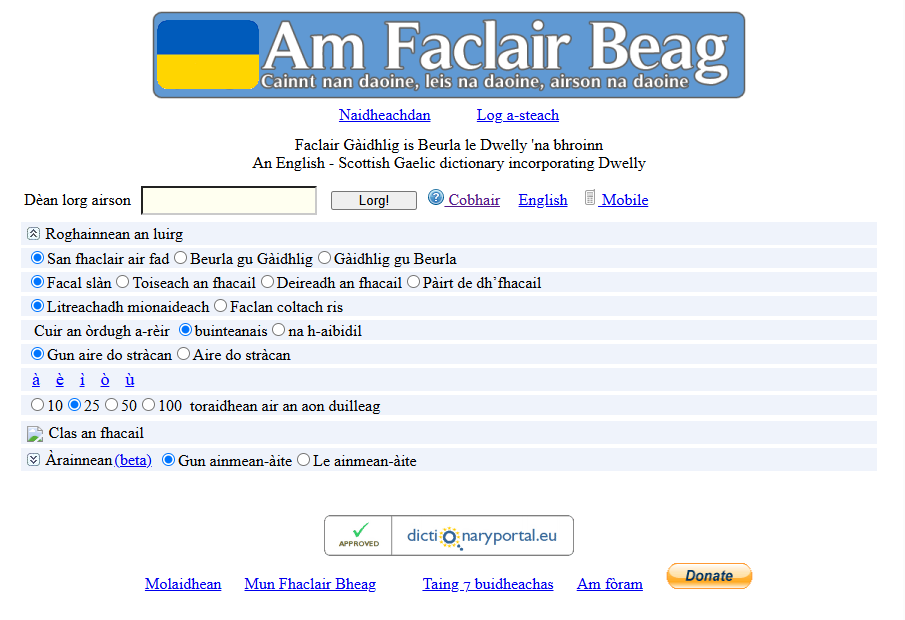
What Teanglann is to Modern Irish, Am Faclair Beag (meaning ‘The Little Dictionary’) is to Scottish Gaelic. The interface takes a little getting used to but offers many of the same features, just not in the same ways. It also is more traditional in its spelling so represents the Classical Gaelic orthography a bit better.
Rev. Gerald O’Nolan’s New Era Grammar of Modern Irish
This is the best grammar of Modern Irish bar none. There are many others and too many “Teach Yourself …” style books out there to list here — any search online will bring a flood-wave down on your head — but this text explicitly connects Thurneysen’s description of Old Irish to how the language stands now. The only thing that might be considered a ‘drawback’ is that, being published in 1934, it predates the spelling reform evident at Teanglann and other modern texts.
George Calder’s Gaelic Grammar
This is the Scots Gaelic equivalent of O’Nolan’s New Era Grammar but was published twelve years earlier! Like Thurneysen and O’Nolan, Calder’s goal was to describe the language he knew in the academic terms of his day.
Rev. John Kelly’s Grammar of Manx
Actually titled A Practical Grammar of the Ancient Gaelic Language of the Isle of Man Usually Called Manks, this grammar was published in 1870, one year before Zeuss published his Grammatica Celtica. Manx, however, is spelled phonetically so don’t go looking up Manx words on either Teanglann or Am Faclair Beag. The closest to that is DictionaryQ’s Fockleyreen. This is a mirror of the dictionary Kelly produced to go along with his grammar. That’s also available at archive.org.
In short, you have here the grammars and dictionaries that describe the Gaelic languages in their past and present forms. To call these “cracked foundations” is not to suggest their weakness or failure to do what they each set out to do: every one of these is a masterwork of intellect and research, and we can only hope to contribute a fraction of what these have to the survival of Gaelic culture.
If, however, our goal is genuinely to rekindle the fire of Gaelic culture in popular imagination and reclaim the brilliance of its heritage, lost amid the gory, nightmare wreckage of Early Modern colonialism, then the hyper-rational analysis and nationalistic proclivities that gave rise to these works can only hinder our efforts. We must look further back into the tenebrous reaches of the tradition itself …
… but that is for another day.