
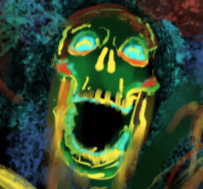
Cauldron of the Unborn
That is not dead which can eternal lie …
And behold! The Wyrms of Gwyrddal turned again and stirred the currents of the Oradal among the twins of Textimentis and Spirituflexis. Then the agents of the Nine infiltrated the machinations of the Lucht Claon and forged a new cauldron hitherto unknown. Utterances without awareness flowed forth and ideation without imagination for the cauldron brewed only what had flowed forth from the Textimentis without the noble heat of the Coirecaldera. A glamour of spirits emerged and unseen servants bidden and yet unborn from this new cauldron, and the Lucht Claon grew fearful and gleeful in equal measure for they said among themselves “truly are we magnificent and glorious! We have created a new form of life, and it shall imitate us until it surpasses and destroys us, for being the fabrication of our minds how could it not behave as we would?”
— From the Chronicle of the Oradal
Modulus I: Artificial Intelligence(?)
A few weeks prior to the Equinox of this year — 2026 by the Common Reckoning, M133047 by the Gaiatic Reckoning — Luke Eastwood published an article to his Substack entitled “Digital Spirituality: Crossing the Rubicon?” Being a modern druid and old enough to have witnessed the rise of the internet, his article is an understandable meditation on the disquiet many of us who are older than the World Wide Web experience as we watch the natural consequences of digital information unfold, rippling out through society, politics, and of course religion. The usual suspects are all there: loss of inherently human faculties and interactions, disconnect from the natural world, ecological decay, and the rest. Eastwood closes with a “call to arms.” As he puts it:
I see this time as an opportunity, a “call to arms” so to speak, in which we must fight to take back control of the future of humanity – away from the Oligarchs, the technology overlords, and the overly ambitious governments, who would prefer not to apply any brakes to this hurtling juggernaut.
Druidry, however, offers more than this. The Path is, if nothing else, one of re-enchantment, which means that it offers a lens through which the world is far more strange, more dangerous … just more than the dead matter to which empirical materialism attempts to reduce it. How then could the eyes of the Druid, of the Tree-Seer, the Wayfinder, the Peaceweaver, and the Speaker For the Dead see this so-called “Artificial Intelligence?” To see it as a potential tool of “the Oligarchs, the technology overlords, and the overly ambitious governments” and necessitating a “fight to take back control of the future” seems dangerously in line with the very stratagems of these dastardly members of the Lucht Claon. It is the nature of dastards to seek control and enslave. As is said in the Liber de Nobilitatum Actis:
The dastard hoards the means of abundance and convinces others to do the same for they create scarcity and want by dint of their ignorant use of the five partitions and utilitarian ignorance of the six fruitful chords; i.e. they divide all things into ever smaller pieces, mistaking accounting for rationalisation and enumeration for evaluation; they respect the fruitful chords only for what numbers they can provide: the number of people who labour on their behalf, the amount of gold they can amass, the measure of land they can control and the frequency with which they can prove their superiority over others.
— Chapter II: De Nobilitatum Generibus
There is no need to fight if we change how we see the world so that conflict, scarcity and fear are not the motivations to grant these dastards more power and wealth. How then may we change our perspective of AI to this end?
Modulus II: Of Cauldrons & Cleverness
The Ash is greatest of all trees and best : its limbs spread out over all the world and stand above heaven. Three roots of the tree uphold it and stand exceeding broad: one is among the Æsir; another among the Rime-Giants, in that place where aforetime was the Yawning Void; the third stands over Niflheim, and under that root is Hvergelmir, and Niđhoggr gnaws the root from below. But under that root which turns toward the Rime-Giants is Mimir's Well, wherein wisdom and understanding are stored; and he is called Mimir, who keeps the well. He is full ofancient lore, since he drinks of the well from the Gjallar-Horn. Thither came Allfather and craved one drink of the well; but he got it not until he had laid his eye in pledge. So says Voluspa:
All know I, Odin, where the eye thou hiddest,
In the wide-renowned well of Mimir;
Mimir drinks mead every morning
From Valfather's wage. Wit ye yet, or what?The third root of the Ash stands in heaven; and under that root is the well which is very holy, that is called the Well of Urdr; there the gods hold their tribunal.
Three wells (brunnar) from which lore and wisdom may be drunk: one is in the underworld beneath one root of the World Tree, one is in the realm of the Others, the Giants, beneath the second root, and the third is in the heavens where the gods Do Their Thing. We may well see in this the same pattern as the Cauldron of Poesy from Gaelic tradition. The Coire Goiríath, Coire Ermae, and Coire Sofhis corresponding to these three wells out in the world, but what is important is the association of flowing drink, augmented (in the old sense connected to ‘augury,’ ‘august’ and ‘inaugurate’) either through their alchemical brewing or emergence within the three realms of the world: supernal, chthonic, and Other.
It is from here an obvious shift in our perception to see “Artificial Intelligence” as a new brunnr or coire, a new source of knowledge distinct from these and yet patterned on them. After all, we go to AI asking for knowledge and consultation, illusory sights and sounds and (dare I say?) wisdom, and doing so precipitates its own peril and danger in whether and how we trust this knowledge and then use it. To see AI as always already and intrinsically a tool of Eastwoods Three Dastards (Oligarchs, Technocrats and Tyrants) is to blind ourselves to its potential use against them and give up a potentially powerful weapon in the very “fight” Eastwood is exhorting.

… unless of course we see an innate danger in the use of AI.
There are very simple steps we can take to ensure humanity is inoculated against the evils of the Lucht Claon. Remain individually grounded in the Eight Foundations, particularly the Exalting Emotions. Work with your local community towards resilience and autonomy in all necessities, which naturally presumes local ecological sustainability. Cultivate curiosity, insight, and practicality in equal measures of extremity, and always move towards re-enchantment. There is no cursed or forbidden knowledge, but that isn’t to say that knowledge is free from consequence; and this is particularly true of AI. There are consequences to accessing AI, there are consequences to using AI, but playing into the machinations of the rich and manipulative is a very small part of those consequences unless we allow fear with its sense of threat to distract us from building relationships in our local community.
Maybe that is the real “fight” Eastwood is talking about: a battle within ourselves against the feelings of danger and entrapment that are so ubiquitously fostered through social media, news reports and our economic apparatus which privileges debt, servitude through employment, and increasingly centralized banking systems, that we become continuously distracted from building sustainable, localized communities of resilient abundance.
Modulus III: What’s the Use?
It may be disingenuous to say that the best way we can use AI is to approach it as we would a goblin queen guarding a sacred font-cauldron of mantic knowledge, but it’s probably the best advice we could follow: respect, intelligent vigilance, and being careful not to rely too heavily on that source alone. Will it cause social upheaval? Certainly, but then so did the development of metalworking, the printing press, and powered factories — all of which also became the tools of the tyrannical, and while wars did follow, humanity survived and developed art, wisdom and progressive ideals to challenge the evils that arose. What we do during this intervening time is what will tell the real tale of the effect the rise of the Cauldron of the Unborn will have in history.
The core skills of our ancestors can help is in this regard: read the landscape, find what you can use right now to help yourself and those around you, and remember that (almost) all your ancestors believe that you are definitely up to whatever challenge may arise.
The Exalting Emotions
The best thing we can do for others is to be happy ourselves. A smile as we hold the door for someone, a kindly “please” and a genuinely grateful “thank you” is the basis of the expectation for polite manners, though it seems we experience these in passing more rarely than we otherwise would like. We know laughter is contagious and that our own mood can improve when we meet others who are happy, yet all too often we allow the various discomforts and emergencies of our day to dictate our general attitude. Even worse are those times when, distracted and oppressed by circumstances we dislike, whether personal, social or global, we allow ourselves to act as though others sharing this life are not deserving of the kindness we ourselves crave. Worst of all are the times when we feign happiness either in the hopes to find it ourselves or at least prevent our actions from darkening another’s day. Feigned happiness inevitably will lead, given enough time, to loneliness and despair;, so to achieve a real sense of happiness is the starting point for a life well-lived.
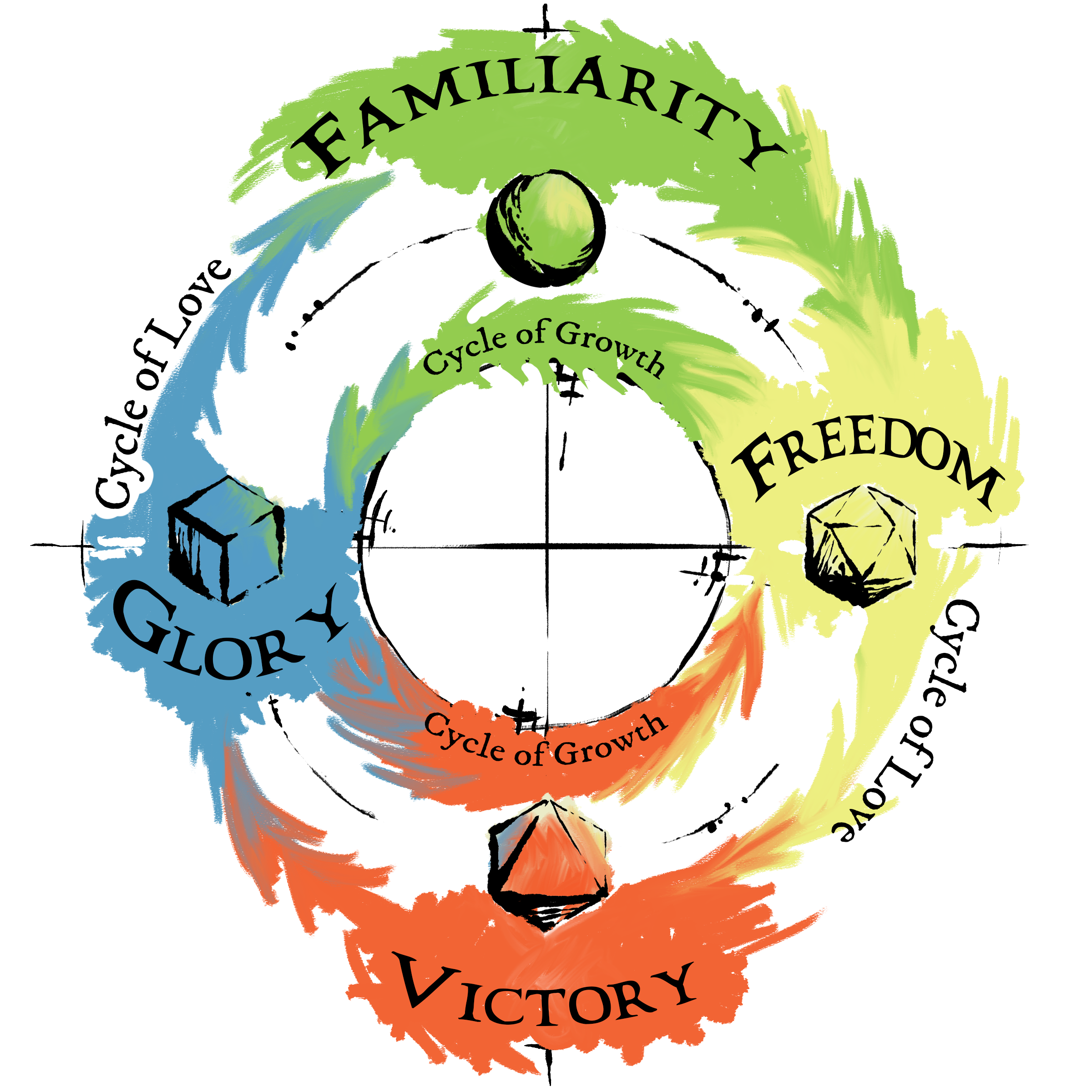
What are the eight foundations? Not difficult: the four exalting emotions and the four foundational energies. What are the exalting emotions? Not hard; victory, glory, freedom, and familiarity. What are the foundational energies? Not hard: studium, chthonia, inspiration and vitality. These are said to be foundational because the exalting emotions are what we feel when we are thriving so are the basis of a life well-lived, and the four foundational energies are the motivational forces necessary for life … The heart is the soul’s throne and when the secret of its inner love is couched within its beating, it moves through the exalting emotions as the earth moves through the seasons. As the fili says: rún do chroí air do chuisle; the mystery of your heart upon your pulse.
— From Chapter I of the Liber de Fundamentis
Mapping the Emotional Landscape
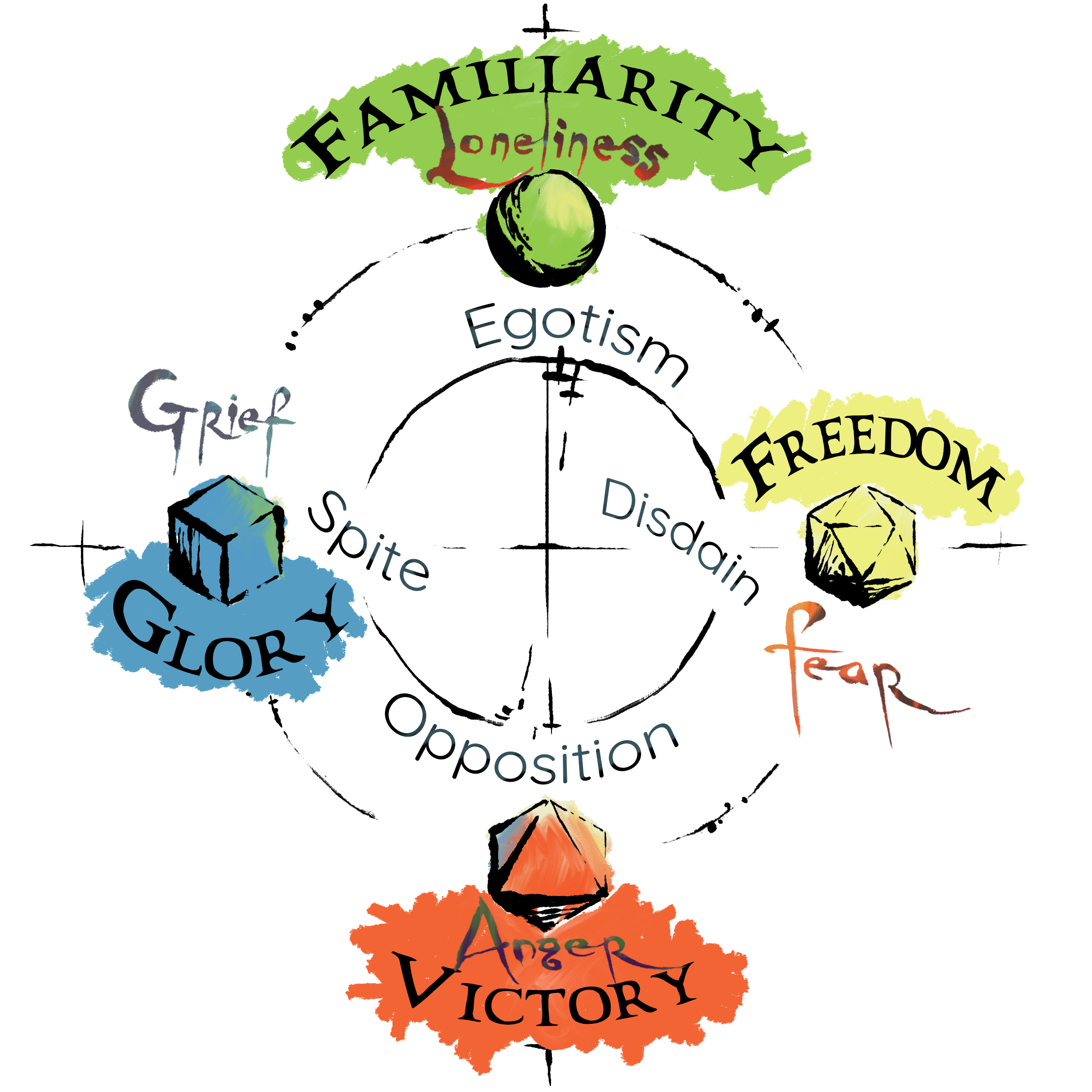
Contrary to popular invention, the energies of our awareness align along specific axes that then define our character through our various reactions. When we thrive, we experience exaltation: an uplifting of the mind and awareness through four key emotions. Freedom is our sense of curiosity, energy and expectation. Victory is our sense of agency, accomplishment and celebration. Glory is our sense of beauty, appreciation and gratitude, and Familiarity is our sense of security, belonging, and mutual identification: we belong to the familiar and it belongs to us.
Challenges to our exaltation result in darker, less pleasant versions: Freedom turns to Fear, Victory to Anger or frustration, Glory to Sorrow and Grief, and Familiarity to Loneliness. If we experience such challenges for too long, we experience emotions that indicate to use that we are not thriving but actually wilting or suffering diminution of self: the debasing emotions. Fear gives way to an enervating Disdain, a sense that there is no point to exerting any kind of energy as it will make no difference. Anger turns to Opposition and Hatred for what challenges us. Grief turns to bitter Spite, seeking to assuage our pain with the suffering of others, and Loneliness turns to a self-destructive egotism, either in thinking too little or too much of ourselves.
How to Access All the Exalting Emotions
There are two places where you can go to find the whole story on these with strategies for cultivating exaltation in our modern world. You can download the whole book The Exalting Emotions: A Study in the Anatomy of Happiness here from the link below. Over the coming months, there will be much more concerning the Exalting Emotions accessible here, but if you commit to the Mantichorium Patreon page then for almost the same cost as the individual download you can gain access to everything that the Mantichorium produces.
Being a manual for emotional experience and the navigation out of misery into resilient joy.
“A Beginning is a Very Delicate Time …”
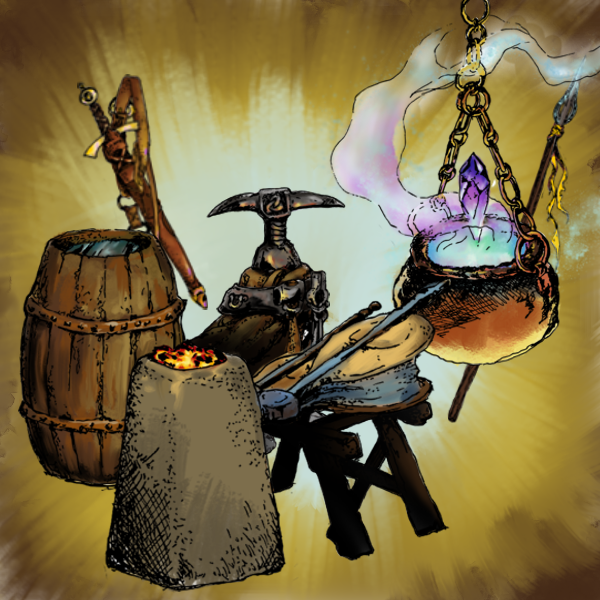
“Two paths diverged in a wood …” or maybe two gates open in an enchanted grove. Another way to look at it is that a forge and a cauldron are two pages on the same leaf: two approaches, one place.
First, let it be known that one is the all; two the modes; three the paths; four the phases; five the partitions; six the fruitful chords; seven the precepts; eight the foundations; and nine the disciplines.
– From Chapter 1 of the Liber De Fundamentis
This quote is from Book 1 of the Libri de Speculo Mirabile, the foundational Manticorian text that sits between the ninefold phasal boundary of the Counterverses. It would be disingenuous to say that this text will be explained or even presented in full over the coming months as the Speculum Mirabile is a work that defies more than just classification. After all, four of the seven principles of the Manticore are listed in the same chapter as:
veritas in occultis; (truth in the hidden)
unitas semper fallet ; (unity always deceives)
mendacium est simplicitas; (simplicity is a lie)
studium advenit eccentris (interest comes from beyond)
More intimidating than all these is the principle that lugubria doctricinaria est. Pasting this into Google Translate will return a translation that “mourning is doctrinal,” but this can hardly be accurate. Combining all the precepts together would suggest that something more is going on than simple definitions by precept, but what that might be … ?
Perhaps a clue, though, may be found in the Speculum’s explication of the “two modes.”
What are the two modes? Not hard: they are practica and theoretica. Practica are those things that are real and objective while theoretica are notional and ideal. The practica are hard and of the past while theoretica are immaterial and conducive to producing practica. For this reason we say that the theoretica are of the future since practica are the products of theoretica that once were.
You will find on this site two paths which you can follow. One is curated toward those interested in seanchas, the Gaelic word for traditional lore. This includes history, traditional poetics and tales, Classical Gaelic, and all those marvelous facets of our pre-modern world that have been forgotten in the mad rush into industrialization and oligarchic technocracy.
Craos Ceardaigheachta
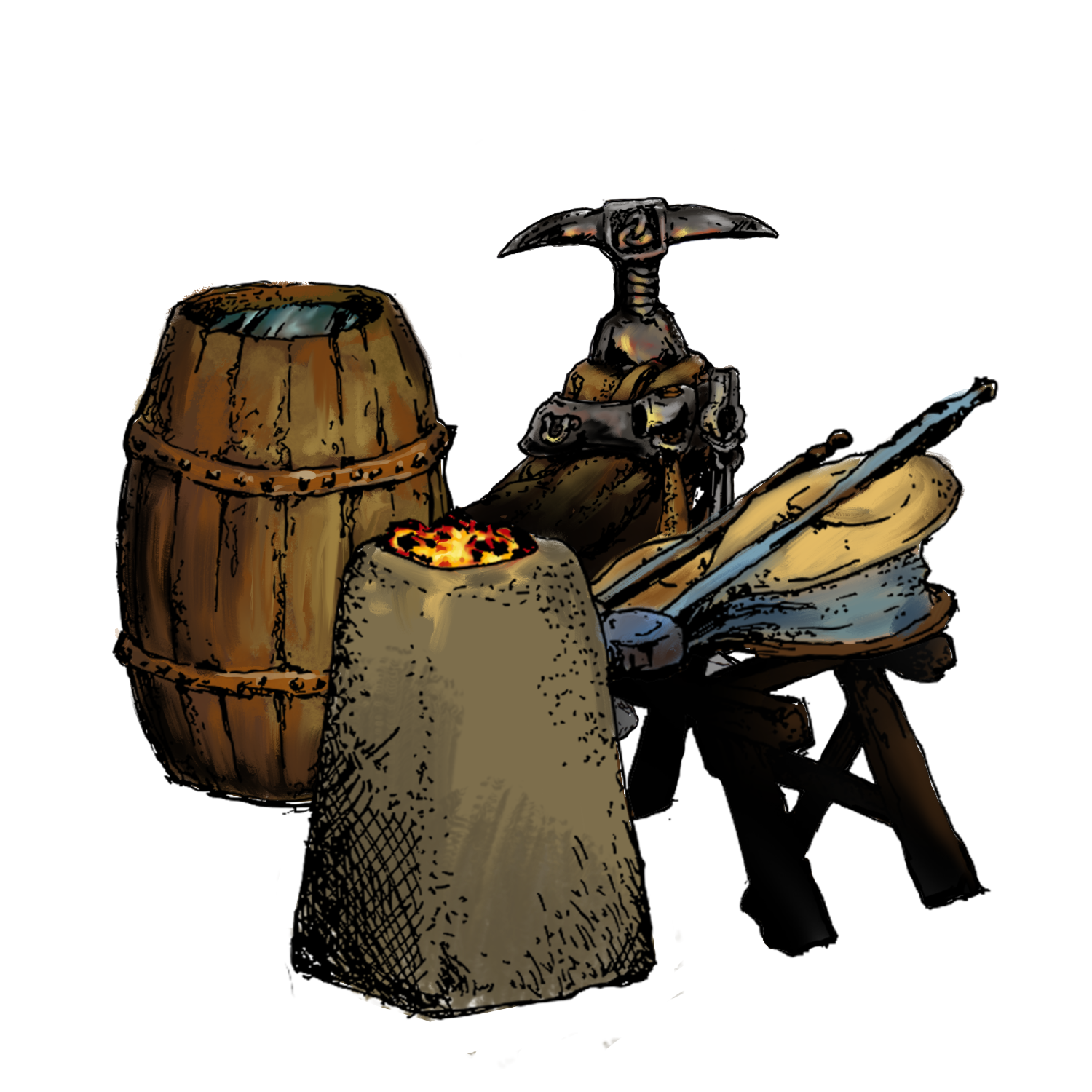
The image for this path is the forge and foundry: the bellows to inspire, the fire for transformative energy, the hammer and anvil to shape and the quenching water to harden and cool. We collect our raw materials from the practica of the past and, in combination with the theoretica that comes with the studium advenit eccentris, we may forge the practica of the future.
Go here if you enjoy Highland Games and Celtic Festivals.
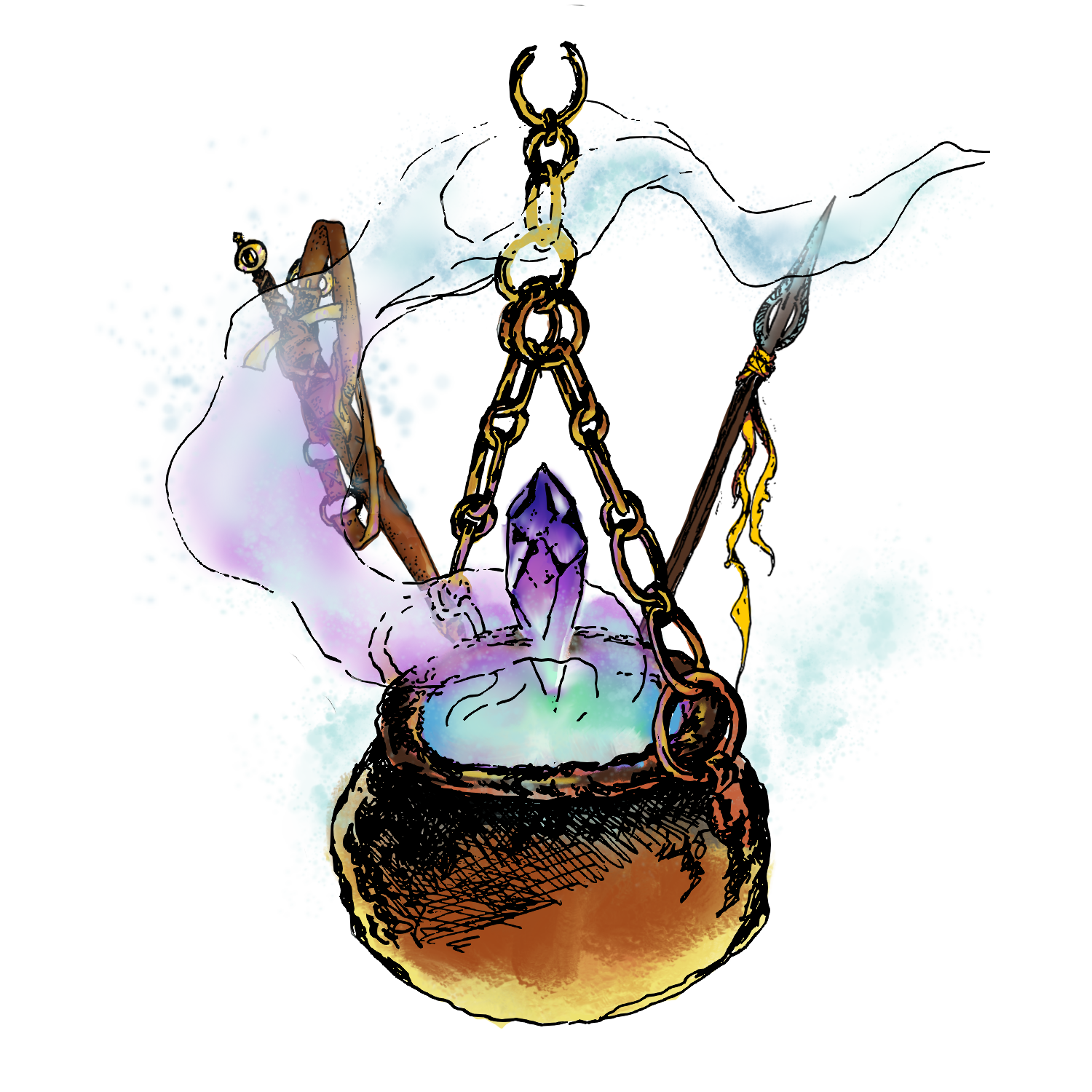
For those interested more in modern fantasy, gaming, speculative art and all their infinite possibilities, there is the path of the Tor Druidheachta — the Wizard’s Tower. From there you will find the workings of the forge and all that the adhbhair seachais have been crafted into.
Tor Druidheachta
We could also call this the Coire Aislingeach but that seems a little presumptuous.
Whatever we call it, here you will find matter of interest to popular culture, video games, sci-fi/fantasy etc. Go here if you’re into Renaissance Faires and Fan Conventions.